Intelligent Ireland

12 · Digital Transformation Academy

Training guide & user manual

A role-based walkthrough of every feature, process and workflow. Each module includes a screenshot, learning objective and step-by-step instructions. All data shown is synthetic.

Your progress0/9
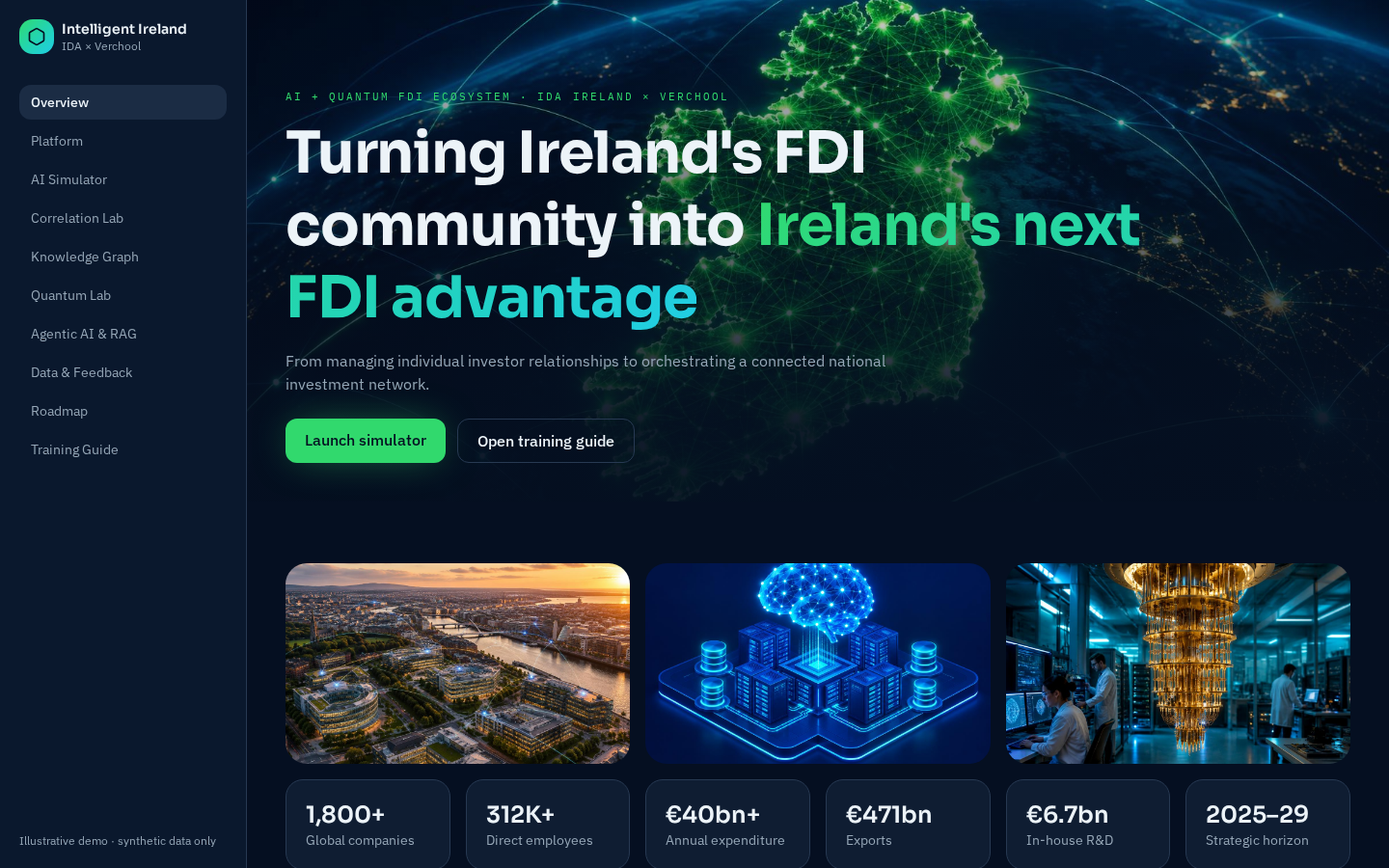
Screenshot of Module 1 · Basics & the FDI flywheel

All users

Module 1 · Basics & the FDI flywheel

Understand the proposition, baseline statistics and the six-stage flywheel.

  1. 1Open Overview from the sidebar.
  2. 2Review the six baseline statistics and the data caveat.
  3. 3Click each flywheel stage (Attract → Attract again) to read its purpose.
  4. 4Use 'Next stage' to walk the full cycle.
Try it
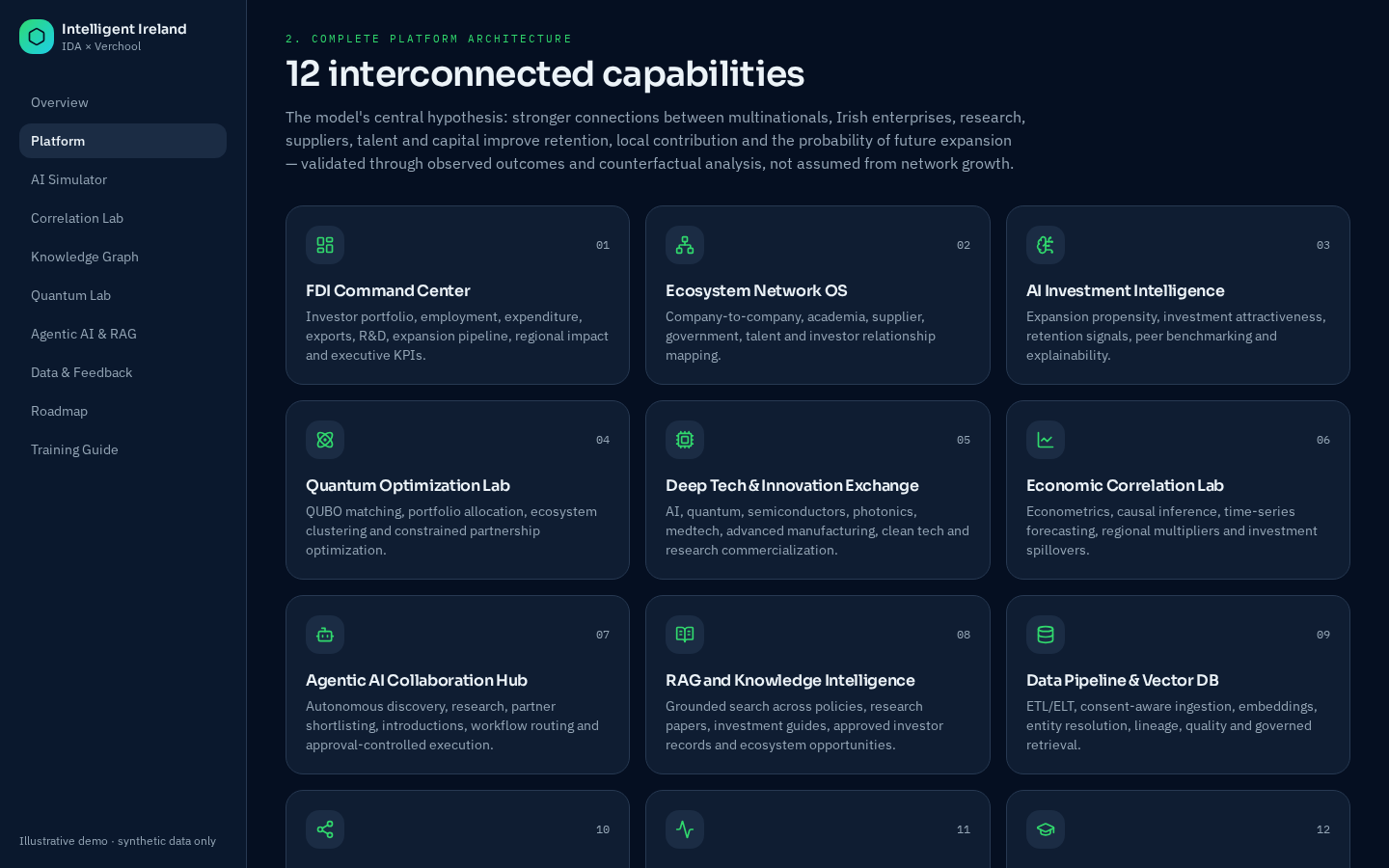
Screenshot of Module 2 · Platform architecture

All users

Module 2 · Platform architecture

Navigate the 12 capabilities and the layered Neural Network OS.

  1. 1Open Platform.
  2. 2Each card links to the lab that demonstrates it.
  3. 3Read the layered stack: Experience → Intelligence → Knowledge → Data → Governance.
Try it
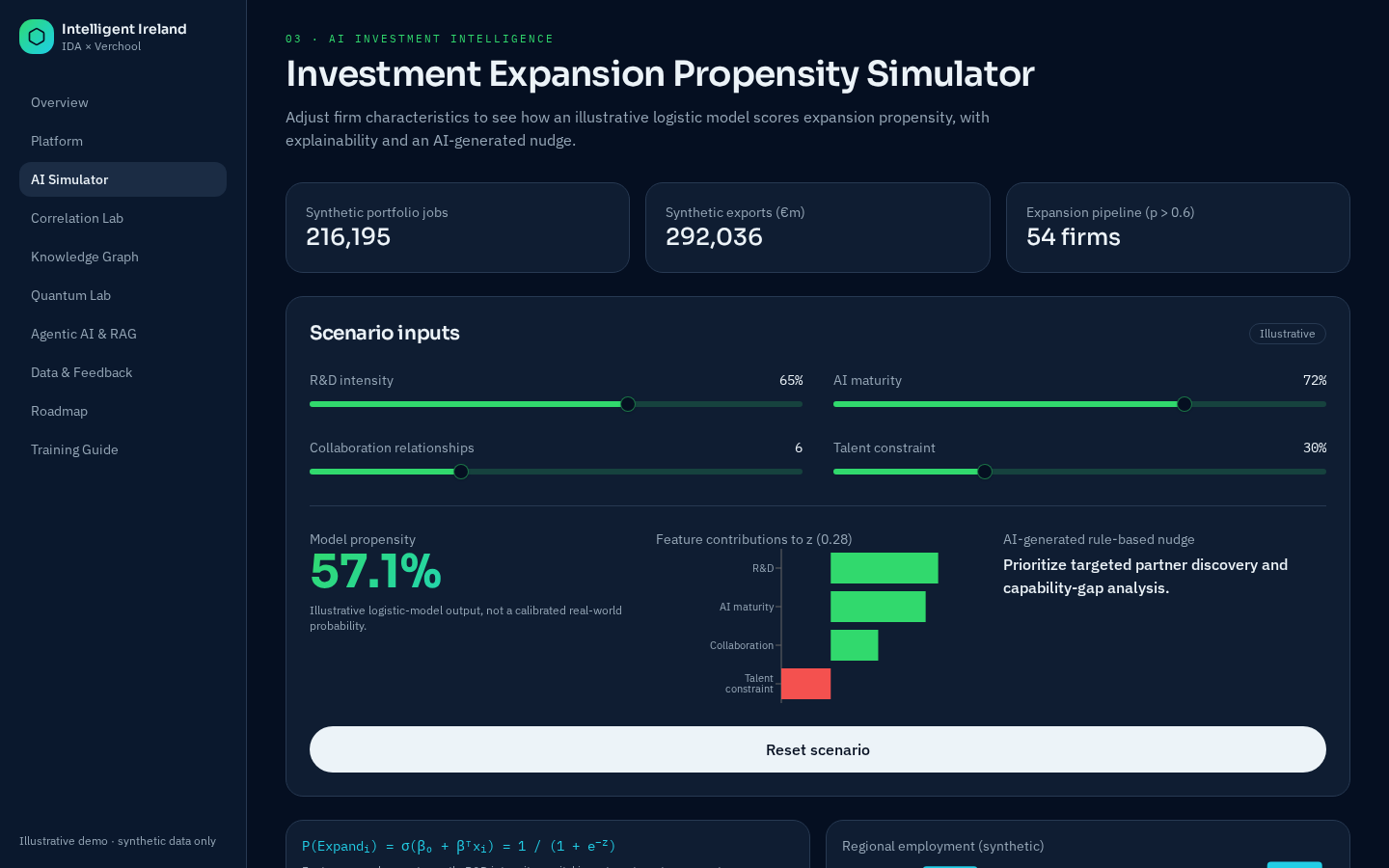
Screenshot of Module 3 · AI propensity simulator & matching

Account executives, analysts

Module 3 · AI propensity simulator & matching

Score expansion propensity, read explainability and act on AI nudges; run partner matching.

  1. 1Move the four sliders (R&D, AI maturity, collaboration, talent constraint).
  2. 2Read the propensity and the feature-contribution bars (green raises, red lowers).
  3. 3Follow the AI nudge recommendation.
  4. 4Scroll to Partner matching: choose a focus sector and tune weights w₁–w₅.
  5. 5Review the ranked shortlist; press Reset scenario to return to the baseline (57.0%).
Try it
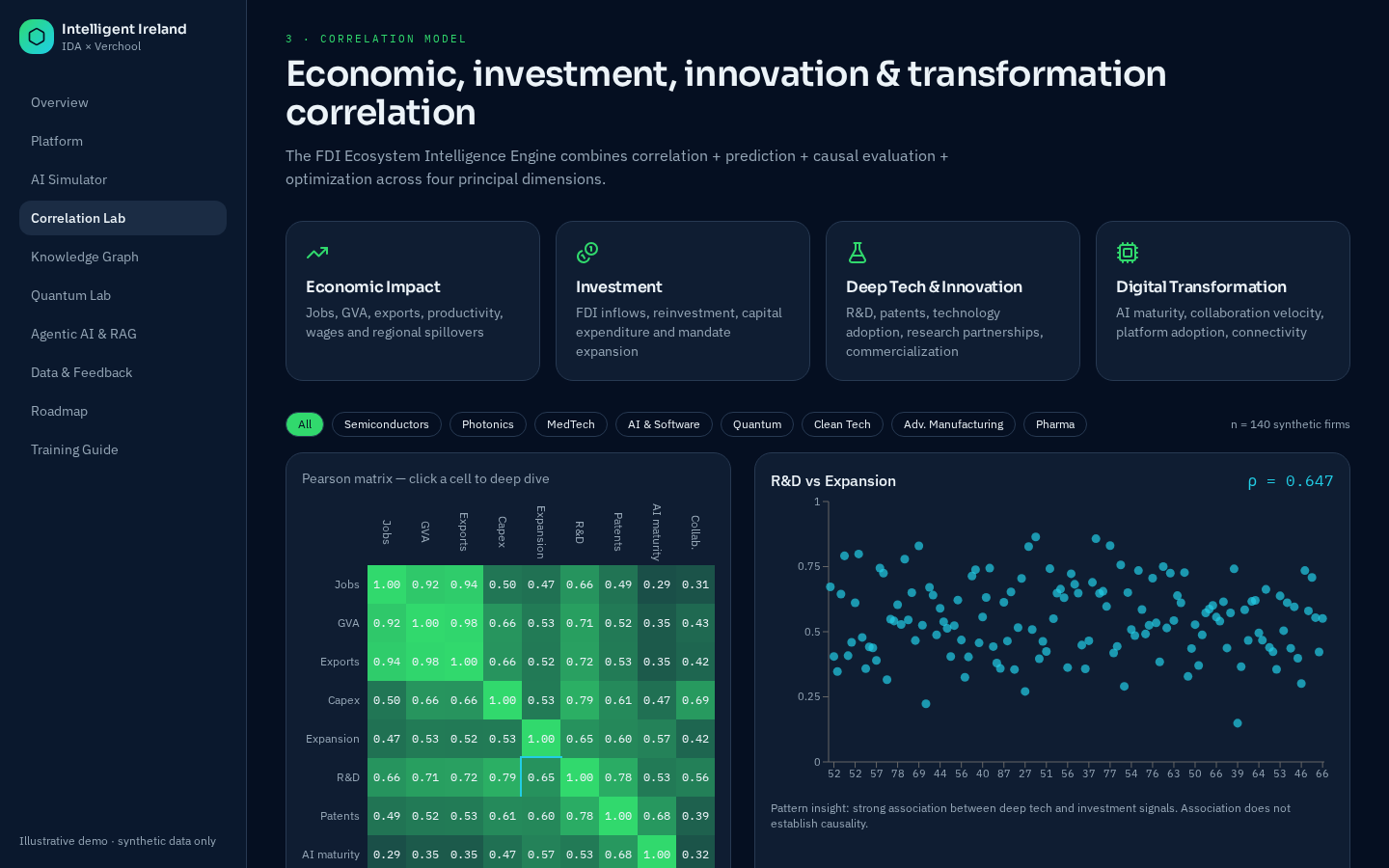
Screenshot of Module 4 · Economic correlation lab

Economists, data scientists

Module 4 · Economic correlation lab

Find patterns across economic, investment, deep-tech and digital dimensions.

  1. 1Filter by sector using the chips.
  2. 2Click any matrix cell to deep dive into that pair.
  3. 3Interpret ρ with the pattern insight — association is not causation.
  4. 4Review ΔGVA split into direct, indirect and induced effects.
  5. 5Consult the formulas: Pearson, ΔGVA and difference-in-differences.
Try it
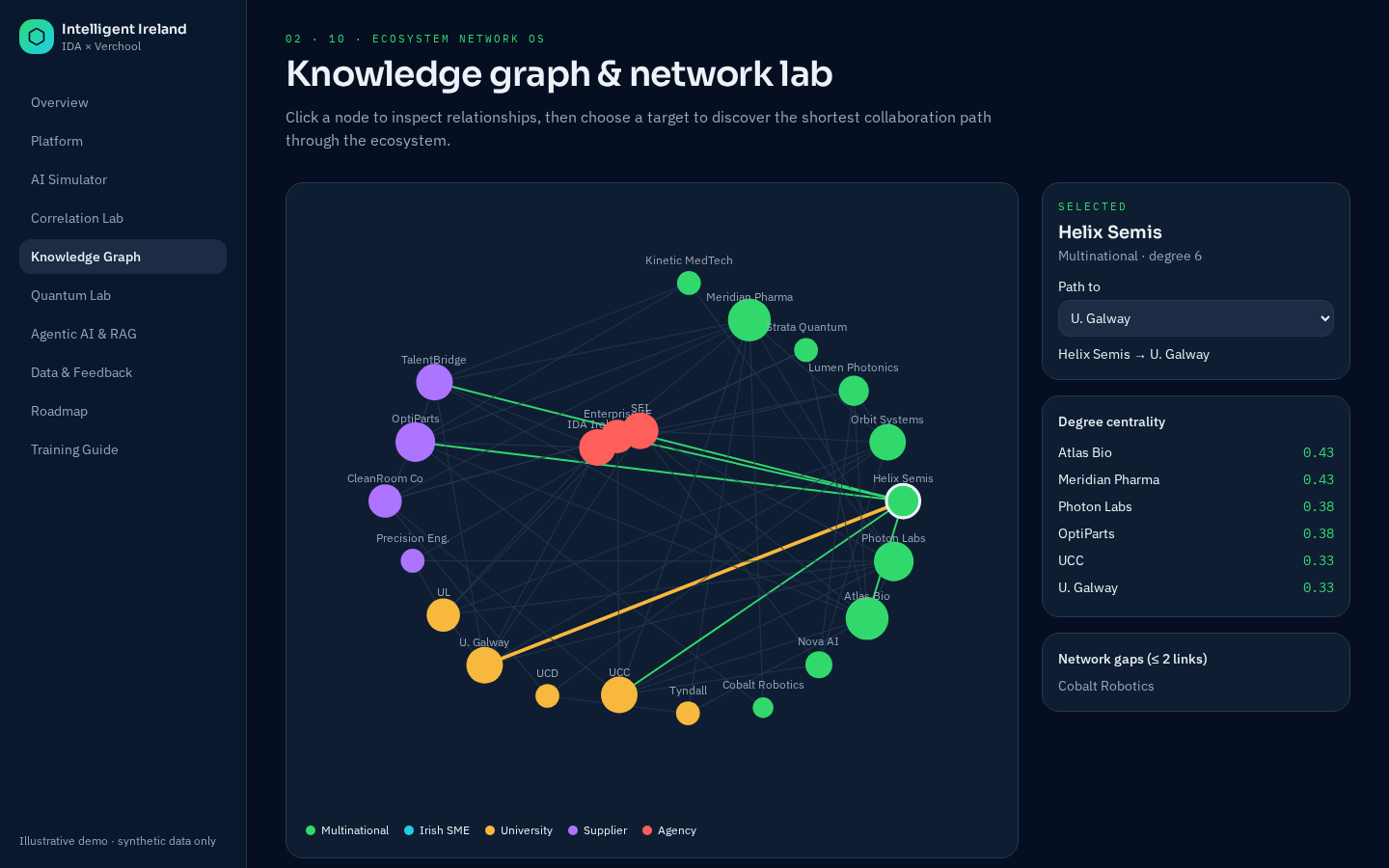
Screenshot of Module 5 · Knowledge graph & network lab

Ecosystem managers

Module 5 · Knowledge graph & network lab

Inspect relationships, centrality, collaboration paths and gaps.

  1. 1Click a node to highlight its connections.
  2. 2Choose a target in 'Path to' to see the shortest collaboration path (gold).
  3. 3Use degree centrality to find brokers.
  4. 4Use 'Network gaps' to target outreach to weakly connected actors.
Try it
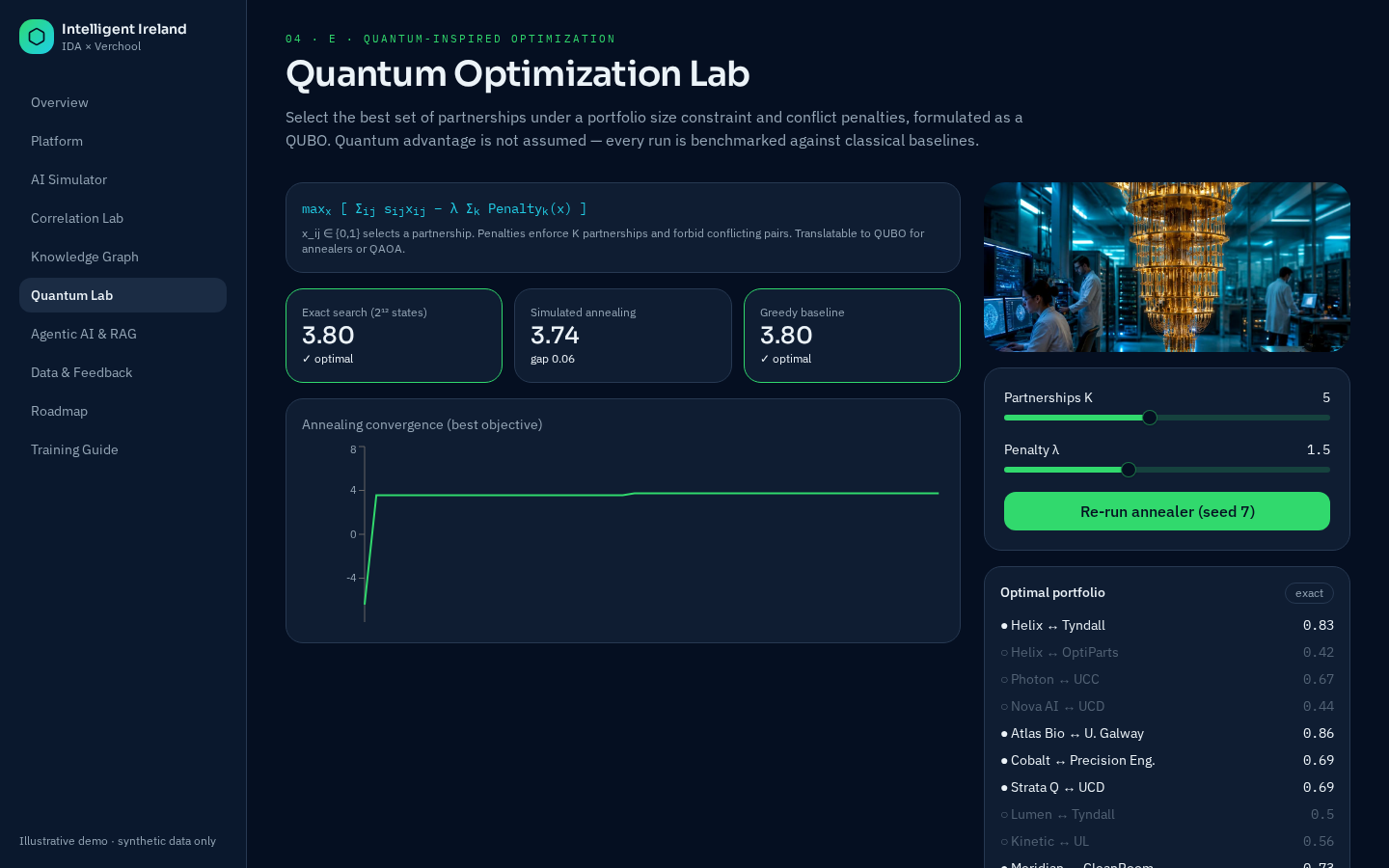
Screenshot of Module 6 · Quantum optimization lab

Data scientists, strategy

Module 6 · Quantum optimization lab

Optimise a partnership portfolio as a QUBO and benchmark solvers.

  1. 1Set K (portfolio size) and λ (penalty strength).
  2. 2Compare exact, annealing and greedy objective values.
  3. 3Re-run the annealer with new seeds to test robustness.
  4. 4Read the optimal portfolio and conflicts list.
Try it
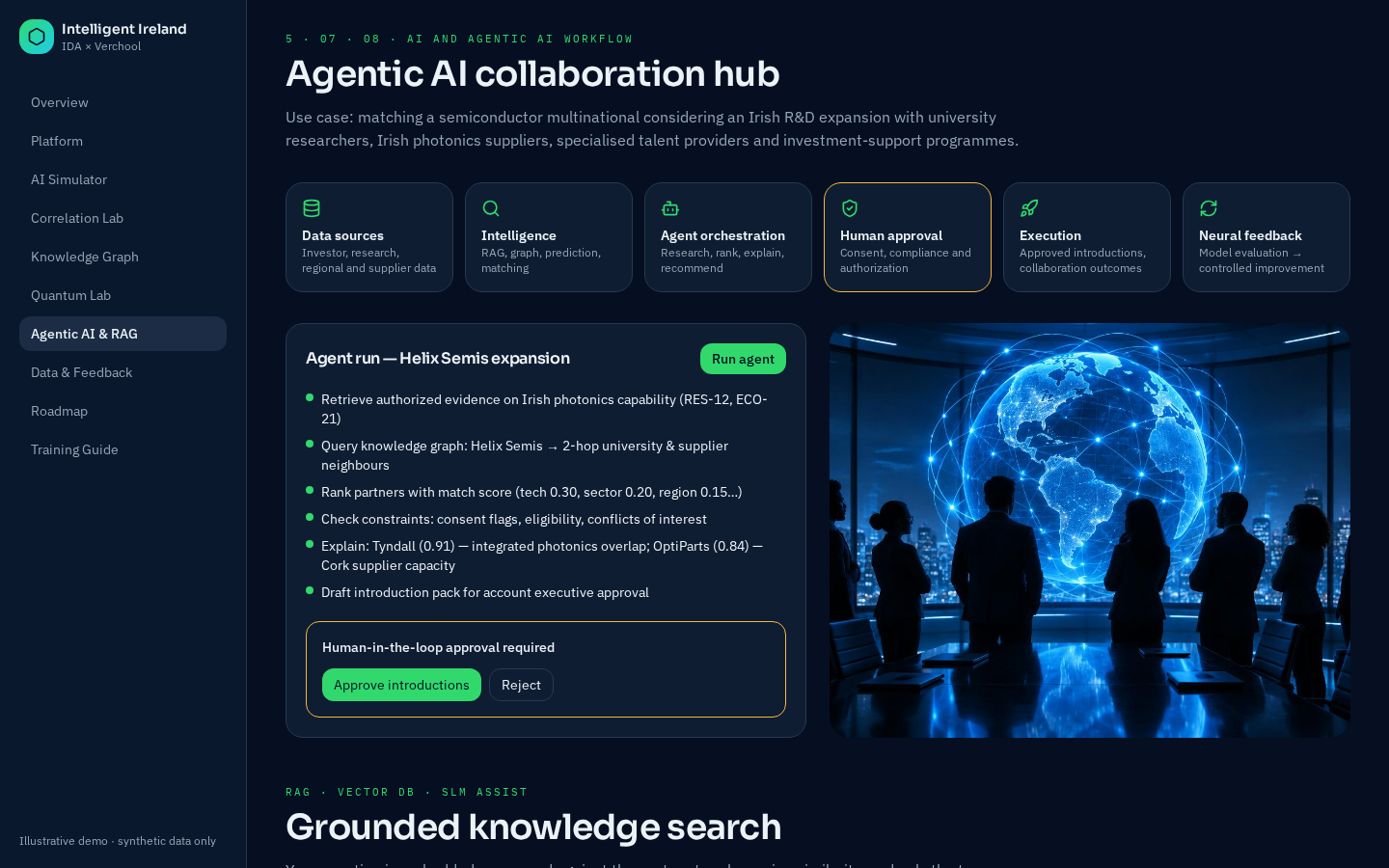
Screenshot of Module 7 · Agentic AI, RAG & SLM assist

Account executives, compliance

Module 7 · Agentic AI, RAG & SLM assist

Run an approval-controlled agent and grounded knowledge search.

  1. 1Press 'Run agent' and watch retrieval, ranking, constraint checks and explanation.
  2. 2Approve or reject introductions — both are logged as feedback.
  3. 3Type a question in the knowledge search; review top passages with cosine scores.
  4. 4Read the grounded answer and its citations.
Try it
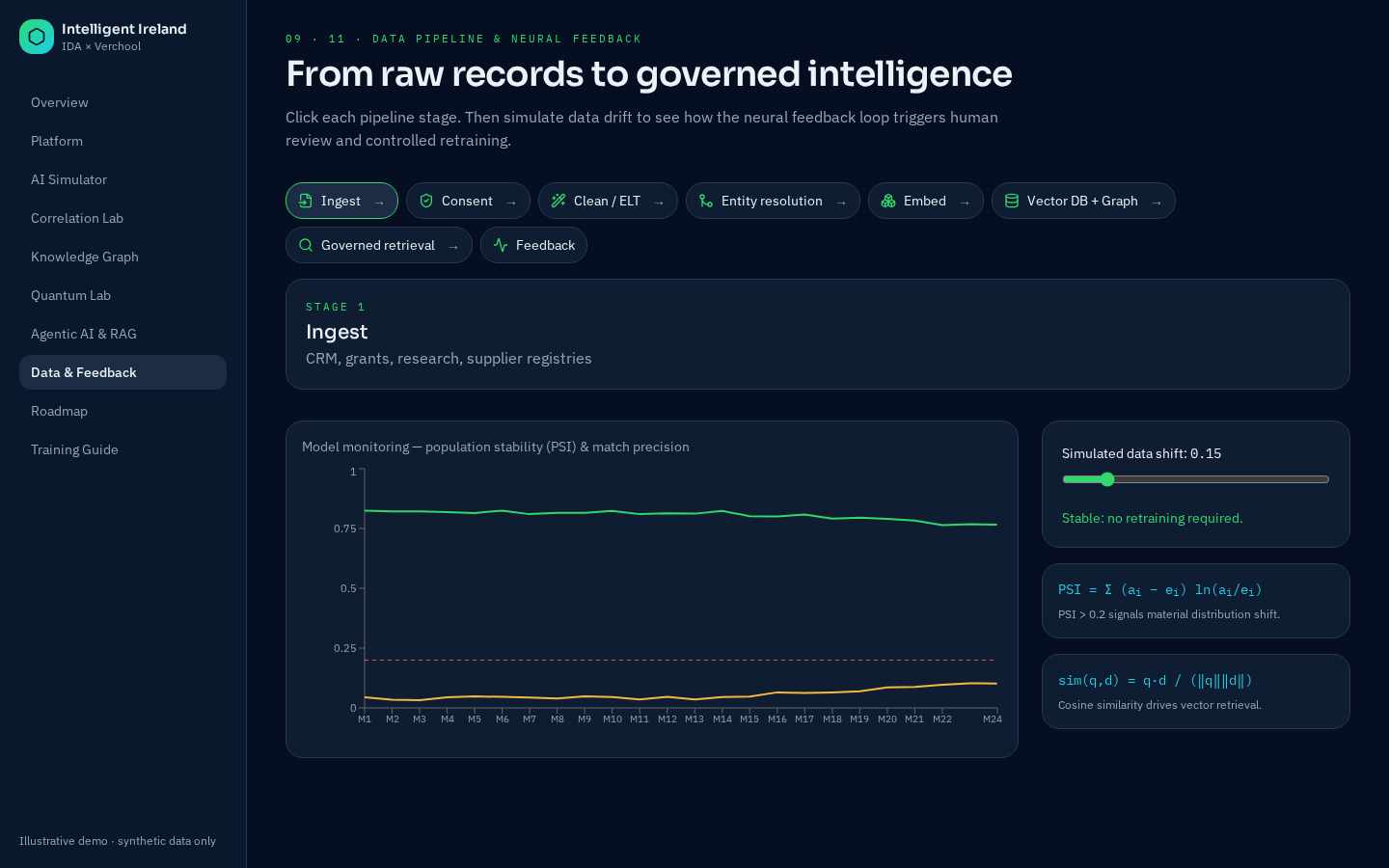
Screenshot of Module 8 · Data pipeline, vector DB & neural feedback

Data engineers, AI governance

Module 8 · Data pipeline, vector DB & neural feedback

Follow consent-aware data flow and monitor drift.

  1. 1Click each pipeline stage from Ingest to Feedback.
  2. 2Increase simulated data shift.
  3. 3Watch PSI cross 0.2 and the drift alert trigger human review and retraining.
Try it
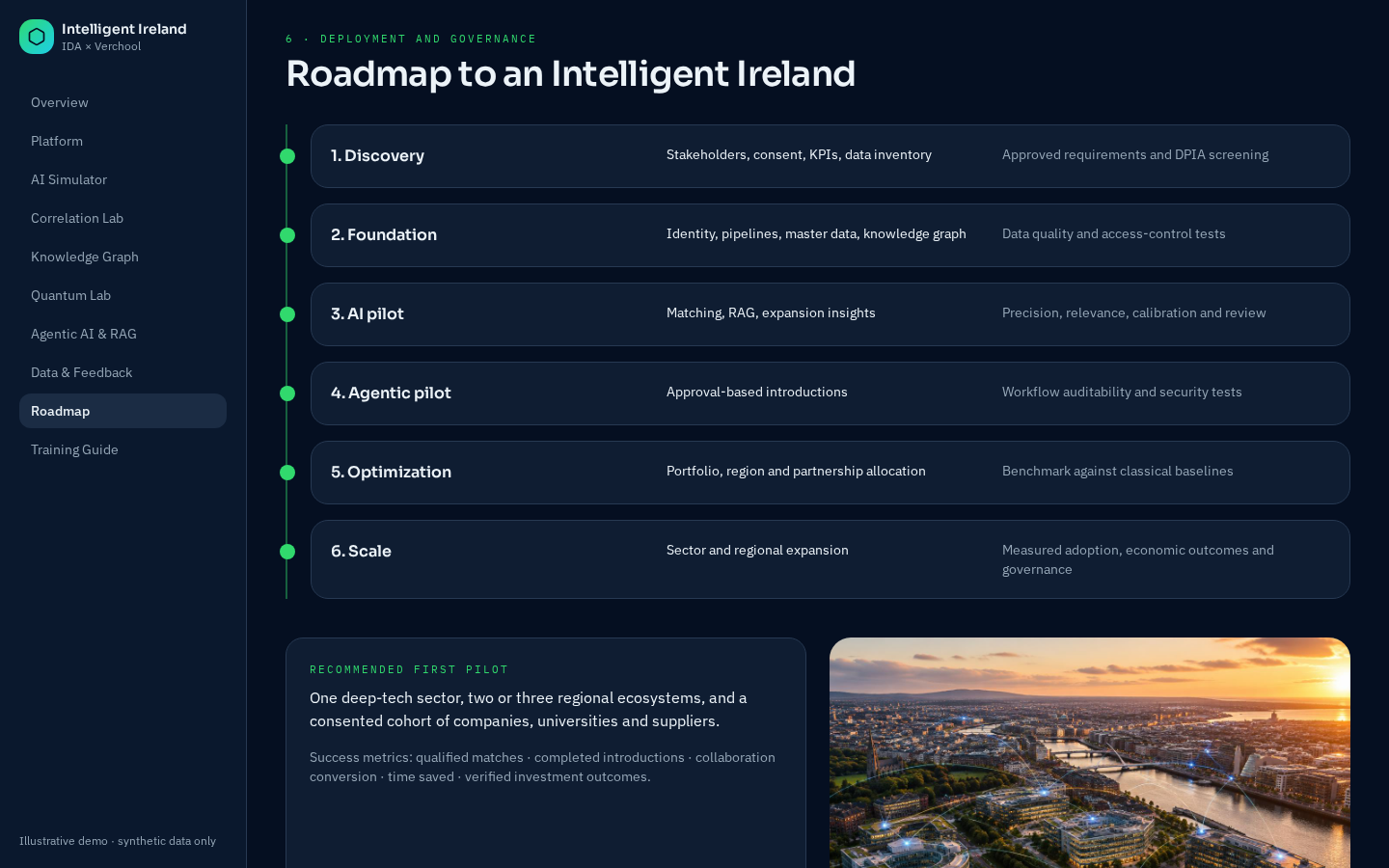
Screenshot of Module 9 · Deployment & governance roadmap

Leadership

Module 9 · Deployment & governance roadmap

Plan phases, acceptance evidence and the first pilot.

  1. 1Review the six phases and acceptance evidence.
  2. 2Agree the first pilot scope and success metrics.
  3. 3Map initiatives to IDA's 2025–29 strategic pillars.
Try it

Glossary

RAG
Retrieval-augmented generation: answers grounded in retrieved, authorized documents.
SLM
Small language model tuned for domain tasks and on-premise privacy.
Vector DB
Stores embeddings for similarity search.
Knowledge graph
Entities and relationships used for paths, centrality and communities.
QUBO
Quadratic unconstrained binary optimization — the input format for quantum annealers and QAOA.
Neural feedback loop
Outcomes feed evaluation, drift monitoring and controlled retraining under human review.